Projects / Job Cost
Use this section to understand how projects are structured, costed, tracked, and managed.
Does your company have multiple internal departments working on the same job?
If yes, how are departments broken out and set up?
What is your job numbering format? How many digits?
ex: 25001, 25-001, 25.001
What does your current phase numbering structure look like?
Often times this is called a cost code in most software
Example:
01-10001 Mobilization
Another example of how a customer did different groupings under phase (cost) codes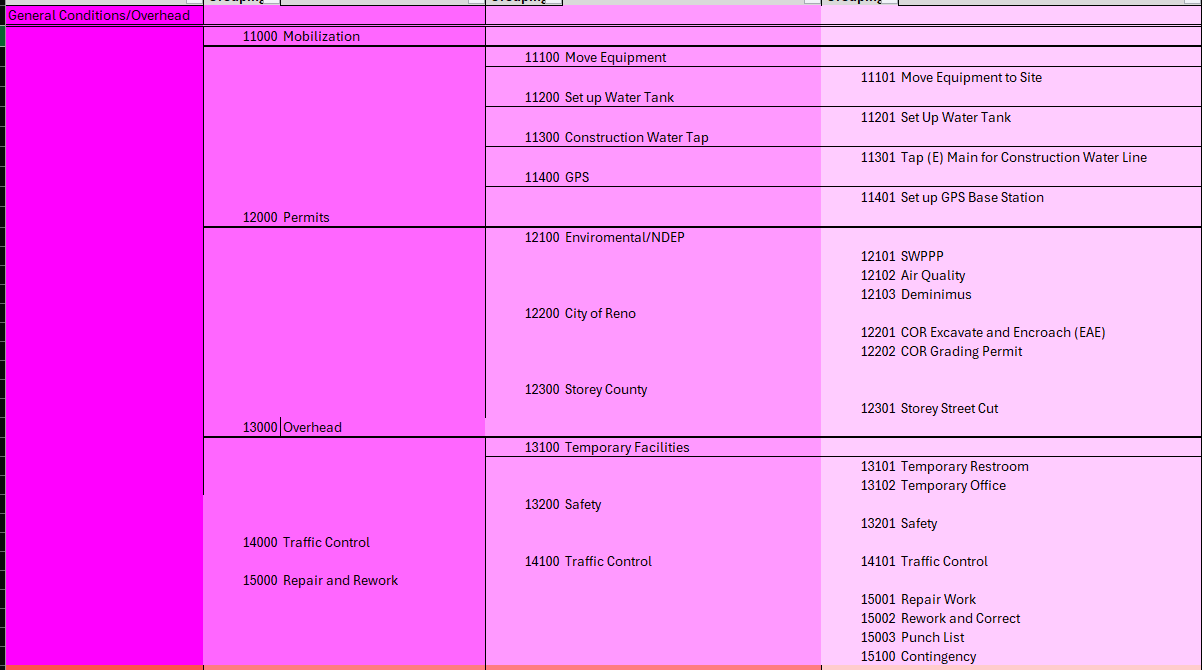
Do you have a master phase list?
What cost types do you use per phase?
In Vista it will break your cost types out per phase ex:
1 - Labor
2 - Materials
3 - Subcontracts
4 - Equipment
5 - Other
6 - Trucking
How do you estimate the cost of work or bid values?
Software, Excel, or other tools?
What does the workflow of your process look like?
Are you currently using a project management system (e.g., HCSS, Procore)?
If you aren't using a software specifically, do you have a workflow or any manual system the Project Managers are using? How are you entering jobs?
Does the bid estimate become the project budget, or are adjustments made for cost-to-estimate comparisons?
What visibility do Project Managers have into costs hitting their projects?
Reports, dashboards, and timing
Are cost-to-complete projections performed?
Are costs tracked within a project management system?
Do you have multiple departments?
Are there multiple job departments? Are these broken out by GL department? Example: multiple plants or divisions and revenue and cost needs to be separately tracked.
Do multiple departments work on the same project?
Do you have your departments broken out on the same job?
Do you break them out by schedule of values or separate contracts by department?
- How many projects are open at one time?
What's the time frame? Do you do long term, short term, a mixture? How many open jobs are going on at the same time?
What is the typical project duration?
Short term - quick jobs
Long term - longer jobs
Do you track change orders?
Do you have a process on tracking pending vs. approved?
Do you track any change orders or do you just add them as needed?
- Is there a review and approval process?
- If there is what does that look like from the time a change order is reviewed until it is approved?
Are pending change orders included in Work-In-Progress (WIP)?
Do you like to consider pending change orders in your WIP or ONLY approved?
Do you issue formal change order documents?
Is there a single standard template?
What types of change orders do you use?
Do you do added schedule of value items?
In what situations would you issue a change order?
What is the decision process on when you need a change order and how is it applied?
What is your change order process?
What does this process look like from conversations in the field up until it's billed?
How are change orders billed to the customer?
How do customers need to see them? Is there a specific way?
How do you track production from the field?
Are you a prime contractor or a subcontractor?
Are you a general contractor or a subcontractor?
For construction companies if you are a general contractor you manage the billing with subs and work directly with the owner. If you're a subcontractor you work directly with the GC. You may have lower tier subs that are helping you, but ultimately the GC is who is responsible.
Do you have open jobs that need to be accurately tracked in Vista and/or ProjectSight?
This involved high level detail for specific open jobs. OPEN jobs only.
Purchase Orders
This section focuses on purchasing workflows and controls. Understand whether the company formally controls purchasing through a purchase order (PO) process.
Do you issue purchase orders?
Do all purchases require a PO?
Are there spending thresholds where a PO becomes required?
How are purchase orders created?
Who is responsible for creating them (purchasing, project managers, accounting, etc.)?
- Are they created in a software, spreadsheet, or another way?
In what situations are purchase orders issued?
Are they used for inventory, projects, or certain vendors?
How are you using purchase orders currently?
Do you you use PO's to track project costs?
Are vendor invoices matches against POs?
Do receiving teams reference PO's when goods arrive?
Is there an approval process for POs?
Who approves POs?
Are multiple approval levels required?
Do approval amount requirements change based on purchase amount?
How is approval currently tracked?
Is there a standard purchase order template used for all POs?
Is there a company wide PO format?
Do different divisions have different templates?
Do you issue purchase order change orders?
How often do PO revisions occur?
Are change orders formally documented?
Who approves changes to existing POs?
How do you handle sales and use taxes?
Do vendors typically charge tax?
Are tax exemptions used?
Do you have jobs that involve multiple tax jurisdictions?
Do projects occur in multiple states, counties, or municipalities?
Subcontracts (Trimble Pay)
Use this section to understand subcontractor management and compliance. Understand how the company manages subcontractors and subcontracts. This includes tracking compliance and administering payments and changes.
Do you issue subcontracts?
Do all subcontractors receive a formal subcontract?
Is there a standard subcontract template used for all subcontracts?
Is there a company-wide subcontract template?
Are different templates used for different trades or project types?
How often are subcontract templates updated?
What is the approval process for new subcontracts?
Who reviews and approves new subcontracts?
Is legal review required?
Are approval thresholds based on contract value?
Is the process manual outside of your software or are you currently doing this process in a software?
How do you track subcontractor compliance?
Which compliance documents are required before work begins (i.e. insurance, lien waivers, certifications, etc.)
Is compliance tracked manually or through software currently?
Who is responsible for monitoring compliance?
Are expiration dates tracked and monitored?
What is your process when a compliance item is missing or has expired?
How are subcontract payment values determined?
Do subcontractors submit payment applications?
Are payments tied to milestones or percent complete?
Do you withhold retainage?
Is there an approval process for subcontract payments?
Who approves subcontractor invoices or pay applications?
Are multiple approvals required?
Are compliance requirements verified before payment approval?
Is approval tracked manually or within the software?
How are payments issued?
How are payment records maintained?
Do you track stored materials?
Do subcontractors bill for stored materials?
Are photographs, invoices, or receipts required?
Is stored material tracked separately from the work completed?
Do you issue subcontract change orders (SubCOs)?
How frequently are they issued?
What types of changes typically require a subcontractor change order?
How are SubCOs created and issued?
Who creates the subcontract change orders?
Are they generated from project management software or manually?
How are subcontractors notified of approved changes?
Is there a single standard SubCO template used?
Is there a company-wide change order form?
Are they different templates by project type?
Does the template include cost, schedule, and scope impacts?
What is the approval process for SubCOs?
Who approves the subcontract change orders?
Are approval thresholds based on dollar value?
Is project management approval required?
Are subcontractors required to sign before work proceeds?
How do you submit and track RFIs and Submittals?
What system do you use to manage RFI's and submittals?
Are they tracked manually or in a software?
Who is responsible for reviewing and approving them?
Job Billing
This section outlines billing methods and controls.
Do you perform progress billing?
Do you invoice by percentage complete?
Are retainage amounts withheld until project completion?
What does this process look like from start to finish?
Do you perform Time & Materials (T&M) billing?
What does a T&M bill look like?
How do you capture the T&M to bill for a job?
What does this process look like from start to finish?
Is backup documentation required for T&M billing?
What supporting documents need to be presented with an invoice?
Do you perform unit-based billing?
Are quantities tracked daily, weekly, or at completion?
What does this process look like from start to finish?
How are billing amounts determined?
Do you determine these in the software or manually?
What is the approval process for billing?
Who creates the invoice?
Who reviews the invoice?
Is there final approval needed?
Is there one standard billing template, or are invoices customer-specific?
How many variations exist?
Are there customer specific fields that are needed?
Are there any other job billing scenarios to consider?
Do customers require separate billing by location or department?
Do you handle intercompany billing?
What methods are used to deliver invoices?
Are there invoices that need to be uploaded on customer portals? If yes, what is the percentage?
Service Management
Use this section to understand service operations and workflows. The goal is usually to understand how work is requested, scheduled, performed, documented, approved, and billed.
How many service technicians and trucks do you have?
Do you specialized technician trades or skill sets?
How many service vans/trucks are assigned to technicians?
Do you track truck stock per vehicle?
How many service calls are completed each month?
Approximately how many calls are completed daily, weekly, or monthly?
What are your peak seasons?
What percentage are emergency calls?
How many scheduled maintenance contracts and visits do you have?
Who identifies or approves new service work?
Does someone review requests before work is scheduled?
How do service requests get entered into the system?
Who assigns work and dispatches crews?
What is your current scheduling process?
Are there dedicated dispatchers?
Where is the scheduling currently being done?
How do technicians complete work orders and prepare them for billing?
Is this by paper or a mobile device?
Do technicians add their own materials and enter labor hours?
Are photos required?
Are customer signatures required?
Are purchase orders used on work orders?
How are PO numbers tracked?
Are work order bills reviewed and approved?
What is being reviewed on the work orders?
Who reviews completed work orders?
Is there an approval process required?
Do you offer maintenance contracts or warranty agreements?
What types of service agreements do you offer?
How many customers covered under agreements?
What services are included?
How are renewals managed
How are service contracts billed?
Are contracts billed monthly, quarterly, annually, or on any other scheduled?
Are these fixed amounts or do they vary?
Equipment Management
This section focuses on owned equipment and related costs.
Do you own equipment?
Approximately how much?
What types of equipment do you own?
Do you lease or rent equipment?
Approximately what percentage is owned vs. leased or rented?
Where do you track and maintain records currently?
Is all equipment tracked or only larger assets?
Do you have a maintenance facility?
Is maintenance performed in house or third party?
Do you have one shop or multiple locations?
Do you have dedicated mechanics?
Is preventative maintenance performed?
How is equipment service and maintenance tracked?
What system do you use to track maintenance?
Who creates maintenance work orders?
Who does maintenance scheduling?
Are outside vendor repairs recorded?
Are labor and parts tracked separately?
Is equipment inspected regularly?
How are inspections logged?
Are inspections completed on paper or electronically?
Are inspections required daily, weekly, monthly, or annually?
Who performs inspections?
Do you maintain an inventory of parts?
How is this tracked?
Are consumables tracked?
Who manages inventory levels?
Are tires, fluids, filters, and maintenance supplies tracked?
Do you have a system for re ordering?
How is equipment tracked and dispatched?
Who assigns equipment to jobs?
How do field crews request equipment?
Is there a dispatch coordinator?
How do you track where equipment is located?
Is GPS tracking used?
If so, what system?
Is GPS installed on all equipment or only certain assets?
Is idle time monitored?
Are maintenance alerts generated?
Who monitors GPS activity?
How is equipment usage charged to jobs?
Are jobs charged hourly, daily, weekly, monthly, or another method?
Are rates standardized?
Who enters equipment usage?
Is fuel included in the rate?
How is equipment depreciated?
Which system manages fixed assets?
Is depreciation calculated internally or by your CPA?
How often is depreciation calculated?
Who records asset additions and disposals?
Inventory
Use this section to understand inventory tracking and valuation. Understand how materials are purchases, received, stored, counted, valued, issued to jobs, and sold.
Do you keep inventory?
What types of inventory do you maintain?
Is inventory kept at one location or multiple warehouses?
Do you stock materials, tools, consumables, or finished goods?
Is inventory for internal use or do you sell it to customers?
Do you track all inventory or only certain things?
Who is responsible for managing inventory?
How many inventory categories do you maintain?
Do different departments maintain separate inventories?
Are inventory items assigned item numbers or SKUs?
How is inventory counted and tracked?
How are inventory quantities updated?
Do you perform physical inventory counts?
Who performs inventory counts?
Is inventory sold to customers or charged to jobs?
Is inventory primarily used internally or sold externally?
How is inventory assigned to a job?
Who records inventory usage?
How are costs and prices assigned to inventory items?
How is the cost of a new inventory item determined?
Are are selling prices established?
Are markups standardized?
Do you have tiered markups?
Do pricing rules vary by customer?
How often are prices reviewed and updated?
Material Sales
This section addresses material production and sales. Understand how materials are produced, inventories, transferred, sold, hauled, and billed.
Do you maintain aggregate stockpiles or pipe inventory?
How many types?
Are materials stored in stockpiles, bins, tanks, yards, or warehouses?
Do you track bulk materials differently than individual inventory items?
Are materials stored at multiple locations?
Do different locations maintain different products?
Are materials owned by your company or customer owned?
Do different divisions maintain separate invoices?
Do you operate plants that produce materials?
What types of plants?
Example:
Asphalt
AggregateConcrete
Crushing
Batch plant
Other
How many plants do you operate?
Are production quantities tracked daily?
Are materials transferred between plants?
Do you sell materials to outside customers?
How is invoicing handled?
When are invoices generated?
Who reviews?
Do customers pick up materials or do you deliver them?
Are quotes required before a sale?
Are taxes calculated automatically?
Is material used for internal jobs?
How is it charged to jobs?
Who enters material usage?
Do projects receive materials from your own inventory?
Are internal transfers common?
Who requests internal material?
Do you haul materials internally or use third-party vendors?
Do you own trucks?
Do subcontractors haul materials?
Is it a combination of both?
How are hauling assignments made?
How are haul tickets tracked?
Are trucking costs billed separately?
How are material prices determined for customers or internal job charges?
Are prices customer specific?
Do prices vary by location?
How often are prices updated?
Who maintains pricing?
Are transportation charges included?
Are fuel surcharges applied?
Do you currently have software in place to manage material sales?
What software are you using today?
Is it integrated with accounting?
Is inventory managed in the same system?
Does the software generate invoices?
Do it manage scale tickets?
What processes are still handled in spreadsheets?
Was this article helpful?
That’s Great!
Thank you for your feedback
Sorry! We couldn't be helpful
Thank you for your feedback
Feedback sent
We appreciate your effort and will try to fix the article